

HEADACHE
- Andrew Ivanchenko M.D.

- Apr 22
- 4 min read

My friend, your neck deserves respect,
‘cause if its muscles are sore –
Expect some vertigo and headache
And probably much more!
A headache can become a veritable nightmare. We all know that, with the possible exception of the dumb colonel from the famous old joke. (“Doctor: Have you ever had a headache? Colonel: Why? There’s nothing to ache in my head, it’s just a bone!”).
Fortunately or not, there’s more to the head than just bones, and there are plenty of reasons for a headache. Some of them, including infections, tumors, and high blood pressure that may end in a stroke, are fairly dangerous. In most cases, however, physicians fail to find an obvious reason for the patient’s agony. Regular headache sufferers often visit one specialist after another without getting any relief (except with respect to their wallets).
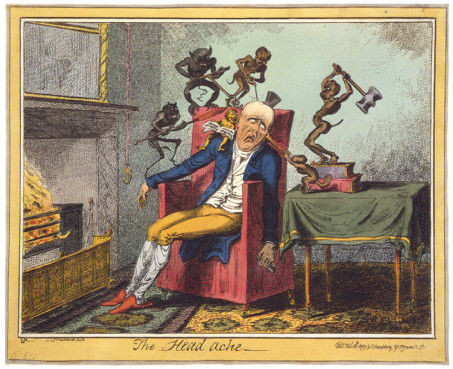
Gate to the head
Since the brain has no pain receptors, a headache emerges elsewhere: in the cranial periosteum, muscles, nerves, arteries and veins, subcutaneous tissue, nasal sinuses, and mucous membranes.
George Crookshank. “Headache” (1819).
Here is a case of a 35-year-old computer engineer. Three years ago, he started suffering from occasional headaches, usually after stress or a sleepless night. An aspirin or an Advil is used to make it go away fast, though. But some time ago, the pain changed: it started increasing gradually and refused to go away. Pills did not help anymore, nor did sleep. A friend taught him how to relax his vertebrae with a crackling sound; at first, this procedure made pain disappear for several hours. Now, however, an even more severe pain would return in just a few minutes and last for days, along with nasal congestion and tearing. He noticed, however, that headache spares him on the days when he spends less time in front of the computer or does more moving around. Does this sound familiar?
Why would a young person without infections, tumors, or hypertension fall victim to regular headaches? And why does physical activity help? Finally, why did his headaches become resistant to medication?
Let’s start with a linguistic observation. In some Slavic languages, the words “neck” and “gate” are closely related. In a way, the neck is indeed the gate to the head.
The neck is the gate to the head. When this gate is open, blood circulation is not obstructed, the brain receives enough oxygen, and there’s no inflammation, pinching or pain.
If this gate is shut, the brain suffocates, starves, and sends distress signals. Adrenaline goes up and so does blood pressure, inflammation starts, biochemical pain mediators are released – and the show starts in earnest!
Descriptions of disorders similar to migraine are over 5 thousand years old. Babylonian literature, dating back from 19th – 16th century B.C., compares headache to bolts of lightning.
When a door is not oiled, it squeaks. As for the spasmed muscles, they produce the “pop” sound that our patient tried to use to align his neck vertebrae. The vertebrae, however, have no choice but to stay where the muscles hold them in place and move wherever these muscles pull them. That’s why it makes little sense to make the poor neck produce those popping sounds. Vertebrae need to be released in a way that would please the muscles and coerce them into good behavior. Don’t try to tear your head off. Learn to respect your body and its self-healing potential – and it will start producing miracles. Otherwise, your neck muscles (that are already overstrained by immobility and stress) may get injured, stiffen, degenerate, suffer inflammation and become a source of agonizing pain if fixed by force.
Reviving neck muscles
In most cases, therefore, your headache is a pain in the neck (literally!), or, rather, in the neck muscles. Abusing these further by making them “pop” and snap is not very wise. They need tender loving care, gentle and patient treatment to recover and get stronger.
Muscles receive blood and food only when they contract and relax. When you start moving your head carefully to explore its potential for mobility, the inflammation and degeneration cease, so spasms and, consequently, headaches disappear.
Reviving these muscles is not rocket science. Any tissue grows when it receives proper nutrition. He who does not work, should not eat. Muscles receive blood and food only when they contract and relax. They feel better even when you start just thinking about them. And when you start moving your head carefully to explore its potential for mobility, your body puts the neck muscles on the list for food allowance. As their inflammation and degeneration cease, spasms and, consequently, headaches disappear.
In advanced cases (where professional help is a must), I would start with manual diagnostics to determine the precise location of the injured area and the spasmed muscles tied to it by the reflex mechanism. Then I would use targeted neuromuscular massage and manual therapy to eliminate spasms and swelling, restore normal circulation, and launch the self-healing process. If needed, I would use additional diagnostic tools such as X-rays, MRI, or lab tests. I would also prescribe appropriate painkillers and anti-inflammatory drugs. Incidentally, the patient whose story I just told you fully recovered after this regimen. Now he visits me once or twice a month, frequents the gym, and gently exercises his muscles several times a day. All that remains of his headaches are bad memories and a resolution not to repeat his old mistakes by giving in to fatigue, sloth, and the deskbound life.
So, if you have problems battling headaches, do not rush to blame your blood vessels, brain disorders, hypertension, or other scary things. Try massaging your neck, stretching the chest segment of the spine, and gently moving your head in all directions. For goodness sake, do not push hard, be patient and slow. When you work on your muscles, especially those in the neck, haste and forcefulness can be highly counterproductive.


Comments